
You built a life here. A job, maybe a family, a routine that finally feels like home. Or perhaps you are simply visiting — a trip that took an unexpected turn. Then one day — a knock on the door, a call to the station, a situation that spiraled faster than you could follow — and suddenly you are navigating a legal system in a language you may not fully speak, with consequences you do not yet understand.
1. The First Hour After Arrest — What You Must Do Immediately {#first-hour}
In our experience handling criminal cases involving foreign nationals, the most damaging mistakes rarely happen in the courtroom. They happen in the first hour: a statement made without a lawyer present, a document signed without understanding its content, a misunderstood question answered under pressure.
Taiwan’s Code of Criminal Procedure (《刑事訴訟法》) guarantees your right to remain silent and your right to legal counsel. These rights apply to you regardless of your nationality or visa status.
Three things you must do the moment you are detained or summoned:
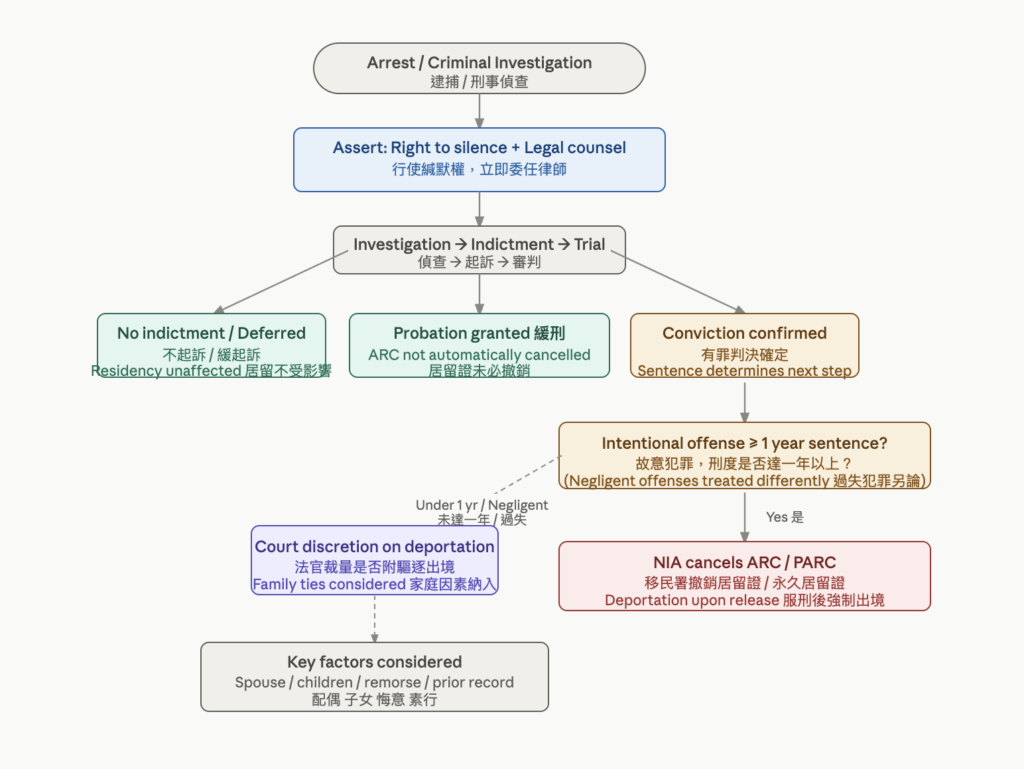
Assert your right to silence. You are not required to answer any questions — not from police, not from prosecutors — until a lawyer is present. Do not attempt to explain yourself or “cooperate” by speaking freely. Statements made during police questioning carry evidentiary weight in Taiwan’s criminal proceedings.
Request consular notification. You may ask the authorities to notify your country’s embassy, representative office, or consulate in Taiwan. Consular officials cannot act as your defense attorney, but they can provide a list of local lawyers and offer logistical support.
Retain a criminal defense lawyer immediately. This is the single most important step. A lawyer can attend your interrogation, prevent harmful statements from being recorded, and begin building your defense strategy from the very first stage of investigation — not just at trial.
Do not sign any document written in Chinese that you cannot read. You are not obligated to do so.
2. How a Criminal Conviction Affects Your Residency Status in Taiwan {#residency}
Many foreign nationals living in Taiwan assume that their ARC (Alien Resident Certificate) or PARC (Permanent Alien Resident Certificate) is safe as long as they do not commit a “serious” crime. This assumption is worth examining carefully.
Under Articles 32 and 33 of the Immigration Act (《入出國及移民法》), the National Immigration Agency (NIA) is authorized — and in many cases required — to cancel a foreign national’s residency permit if they are convicted of an intentional offense carrying a sentence of one year or more of imprisonment.
A few points that clients frequently overlook:
Negligent offenses are treated differently. If your offense was negligent rather than intentional (i.e., you did not mean to cause harm), the automatic cancellation trigger does not apply. The court retains discretion over deportation under Article 95 of the Criminal Code (《刑法》第95條).
The threshold is the sentence imposed by the court, not the maximum penalty for the offense. What matters is what the court actually sentences you to — not what the statute says the crime carries.
Length of residence does not protect you. Whether you have lived in Taiwan for two years or twenty, the NIA’s obligation to cancel your residency status under the Immigration Act does not change based on how long you have been here.
3. Will You Be Deported? Does Having a Taiwanese Spouse or Children Matter? {#deportation}
This is the question we are asked most often — and the honest answer is: it depends on which legal mechanism applies to your situation.
Track One: Mandatory cancellation under the Immigration Act
If you are convicted of an intentional offense and sentenced to one year or more of imprisonment, the NIA must cancel your ARC or PARC by law. This is not discretionary. In this scenario, having a Taiwanese spouse or children does not prevent the cancellation of your residency, and deportation will follow upon your release from prison.
Track Two: Judicial discretion under Article 95 of the Criminal Code
For cases involving sentences under one year, or offenses that were negligent rather than intentional, the picture is different. Article 95 of the Criminal Code states that a foreign national sentenced to imprisonment “may be deported upon completion of the sentence” — the operative word being “may.” The court has discretion, and this is where your personal circumstances genuinely matter.
When arguing against a deportation order in court, we present the full picture of our client’s life in Taiwan: their family ties, their employment history, evidence of remorse, the absence of prior offenses, and the absence of any continuing risk to society. These arguments do not guarantee success, but they are legally recognized factors under the discretionary framework — and they make a meaningful difference in the right cases.
The practical boundary: Family ties protect you in Track Two cases. They do not protect you in Track One.
4. Can You Apply for Probation as a Foreign National? {#probation}
Yes. Foreign nationals are entitled to apply for probation (緩刑) under Article 74 of the Criminal Code on the same basis as Taiwanese citizens.
Probation matters for several reasons beyond simply avoiding incarceration. A probationary sentence signals that the court has assessed you as a low risk of reoffending — a finding that is relevant to the broader question of deportation. In some circumstances, the residency cancellation analysis may also differ where no custodial sentence is served.
Factors that typically support a successful probation application in Taiwan:
- The offense was of relatively limited severity
- You have reached a settlement or reconciliation with the victim
- You have no prior criminal record in Taiwan or elsewhere
- You have stable employment, family, and community ties in Taiwan
- You have demonstrated genuine remorse and cooperated with the judicial process
We work with clients to document and present these factors as early as possible — not just at sentencing, but from the investigation stage onward.
5.Frequently Asked Questions {#faq}
Q: I was arrested in Taiwan. Do I have to answer the police’s questions?
No. Taiwan law guarantees your right to silence. You are not required to answer any questions until a lawyer is present. Do not feel pressured to speak — silence cannot be used as evidence of guilt.
Q: I have a Taiwanese spouse and children. Will that prevent deportation?
It depends on the offense and sentence. For minor offenses or negligent acts, a court may decline to order deportation in part because of your family situation. However, if you are convicted of an intentional offense carrying one year or more of imprisonment, the Immigration Act requires the NIA to cancel your residency regardless of your family ties.
Q: Can I get probation as a foreign national?
Yes. Foreign nationals are eligible for probation under the same legal provisions as Taiwan citizens. Whether you qualify depends on the specific facts of your case.
Q: My family member is in detention. What should we do first?
Contact a criminal defense lawyer with experience in cases involving foreign nationals. A lawyer can apply to visit the detained person, challenge the necessity of continued detention, and begin building a defense strategy before charges are formally filed.
Q: Do I need a lawyer who speaks English?
If you are not fluent in Chinese, yes — this is critical. Not just for communication, but because legal strategy discussions, document review, and interrogation support all require someone who can bridge the language gap accurately and in real time.
This article is provided for general informational purposes only and does not constitute legal advice for any specific case. If you are facing criminal charges in Taiwan, we strongly encourage you to consult a qualified attorney as soon as possible.
Need legal services? Contact us. legal@shiuanyu.com
每個案件的事實與法律關係都不相同,即使面臨相似情況,適合的處理方式也可能有所差異。若您希望針對自身案件進行法律分析、評估風險或規劃後續策略,歡迎透過 LINE 進行首次 15 分鐘線上初談評估,由律師親自回覆。