
不論是跨國婚姻糾紛,還是跨國商務爭端,只要涉及外國法院的訴訟,台灣當事人都可能面臨同一個問題:外國法院的缺席判決(一造辯論判決),究竟能不能在台灣被承認並執行?答案取決於兩件事,起訴書等外國司法文書送達方式,以及你有沒有「應訴」。
閱讀前提醒:
外國判決要在台灣被承認,需要通過多道審查,包含外國法院是否具有國際管轄權、判決內容是否違反台灣公序良俗等。本文聚焦於「送達」與「應訴」這兩個爭點。管轄權有無等其他要件,不在本文討論範圍之內。本文所述為一般性法律觀念,個案情形仍需依具體事實判斷。
從兩個假設案例說起:跨國婚姻與跨國商務訴訟
案例一:
A 女是台灣籍,與美籍的麥可(Michael)在加州登記結婚,婚後定居洛杉磯。三年前,A 女返回台灣定居,戶籍與實際居所均已移回台北,麥可仍在美國。去年,A 女收到從美國寄來的掛號信,翻譯後才知道麥可已在加州法院對她提起離婚訴訟。
案例二:
B 公司是台灣中小型製造業,多年前曾與一家美國客戶發生貨款糾紛。B 公司以為雙方已達成和解,事情就此落幕。某天,B 公司收到一批英文文件,才發現美國客戶早已在美國法院提起訴訟,請求損害賠償,且已取得缺席判決(在台灣稱一造辯論判決),對方正在台灣聲請強制執行。
兩個案例,一個是家事案件,一個是商業糾紛,看似南轅北轍。但在法律面它們面對的核心問題相同:外國法院的缺席判決,能在台灣被承認並強制執行嗎?這個問題很實際,一個台灣人去外國應訴或委任外國律師應訴的成本顯然高於在台灣委任律師在台應訴高。另外,當事人主要財產配置在外國或台灣,也是外國法院判決請求在台確認及執行之考量,這些細節,都是要跟律師諮詢後,討論應對策略,本文礙於篇幅,不在此多做討論。
台灣法律的規定
根據台灣《民事訴訟法》第 402 條,外國法院的確定判決,在符合一定條件下,台灣法院會承認其效力,甚至允許對方在台灣聲請強制執行。條文中有一道保護:敗訴被告若「未應訴」,外國缺席判決原則上不被台灣承認。但這道保護有一個重要的但書「敗訴之被告未應訴者。但開始訴訟之通知或命令已於相當時期在該國合法送達,或依中華民國法律上之協助送達者,不在此限。」。
白話翻譯:若外國法院的起訴通知,已在相當時期以合法方式完成送達,則即使被告沒有出庭,缺席判決仍可能在台灣被承認。
因此,法律適用上有兩個核心:第一,起訴書的送達方式是否合法;第二,被告有沒有「應訴」。這兩個問題彼此關聯,共同決定外國缺席判決在台灣的命運。
第一個核心問題:外國的起訴書、司法文書送達台灣方式合法嗎?
以上面兩個案例來說,A 女與 B 公司都在台灣,外國法院若要合法送達訴訟文件,理論上應透過台灣的司法協助管道,也就是外國法院向台灣外交機關提出請求,再轉由台灣法院執行送達,這是《民事訴訟法》第 402 條預設的「合法送達」路徑,也就是最標準的送達方式。
然而現實中由於台灣與其他國家的外交關係或是其他因素,例如境外收送司法文書不便利又或者是外國律師對於訴訟文書在台灣是否合法送達的理解不同、或單純為了便宜行事、節省成本等等,因而發展出各式寄送外國訴訟文書之方式,例如曾有在美國提起的訴訟案透過台灣律師按門鈴的方式,讓台灣的被告不經意的簽收了文件,這樣類似美國電影影集才會出現的片段,在跨海訴訟中,各國律師為了把起訴書送到被告端,無所不用其極,以下整理幾種台灣判決中出現過的方式:



第二個核心問題:被告有沒有在外國「應訴」(出庭)?
應訴,是另一個獨立的、同樣重要的爭點,不能和送達混為一談。
條文的精神是:「未應訴」本是被告的一道保護。若送達合法,這道保護被但書突破,缺席判決仍可能被台灣法院承認。
台灣法院對「應訴」的認定,目前主要有兩種看法
看法一(對上開案例中被告較有利):
應訴的認定,應以被告是否曾實質行使防禦權為準。若被告參與的程序與訴訟防禦無實質關聯,不宜輕易認定為應訴。例如,純粹為了抗辯「送達不合法」而提出書面,未必等同於接受法院管轄、自願應訴。
看法二(對上開案例中被告較不利):
只要被告在客觀狀態下「可以知悉訴訟的開始、可以充分準備應訴」,就已符合應訴要件,不需要真的出庭進行言詞辯論。此見解在台灣部分法院仍有影響力。
如果是委任外國律師準備應訴而中途解除委任呢
在實務判決中出現的一種情況:當事人收到外國訴訟文件後感到緊張,委任了外國律師進行初步抗辯,後來因費用或其他問題解除委任,不再參與這個外國訴訟,最終案件在外國遭到缺席判決。
「委任過又解除」的事實,在日後的執行程序中,很可能被對方用來主張被告「曾應訴」。對被告較有利的主張是,一開始委任律師只是在抗辯送達不合法(外國司法文書不是以合法管道送達台灣),因此不應被認定為自願應訴,看起來道理十分充足,然仍有一些台灣法院認為這樣過程已經構成應訴。
透過上面簡單討論,我們可以把個案情形以下列結果呈現
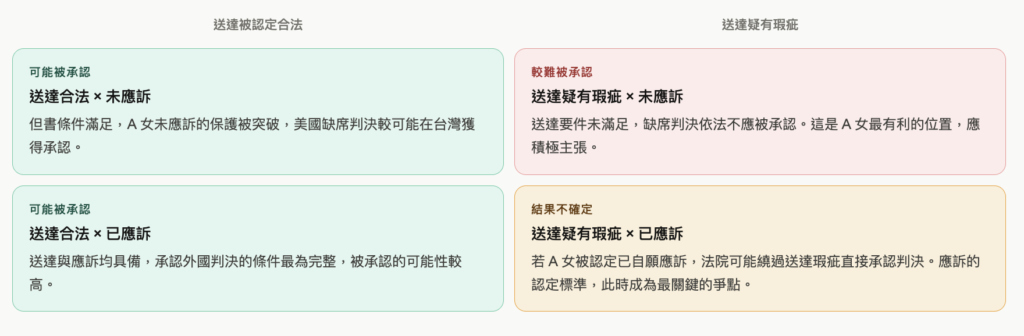
右下角的情境,是實務上最危險、也最容易被低估的位置,送達本身有一些瑕疵,但當事人做了一些回應,被法院認定為已應訴。一旦落入這個格子,缺席判決仍有機會被承認。
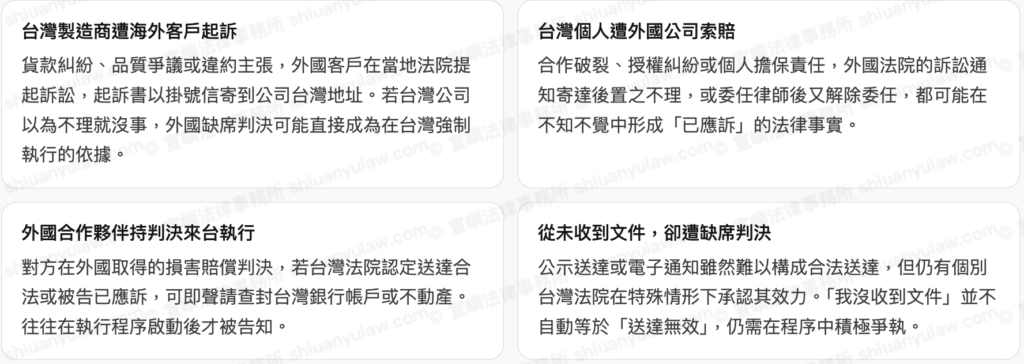
再以下面幾個例子作為實務可能發生的情形:
律師的建議
在跨國訴訟案件中,有幾個情形特別值得提醒。
第一,送達問題和應訴問題必須分開評估,不能混為一談。有些當事人以為只要爭執「送達不合法」,就能阻止外國判決在台灣生效;卻沒意識到,自己在爭執送達的過程中所做的行為,反而可能構成「應訴」,讓送達問題變得不重要。
第二,台灣法院在這兩個爭點上,尚缺乏統一的標準。直接郵寄送達的效力,在不同案件中得出了不同結論;「客觀狀態下可知悉訴訟即為應訴」這個見解,雖飽受批評,但仍有法院接受。這種不確定性,既是風險,也意味著有爭執的空間,前提是要在對的時間點提出。
第三,如果外國的缺席判決已產生,接著便是對方來台聲請強制執行時。然而距離原判決可能已過好一段時間,重要文件例如送達細節(郵政簽收紀錄)、當年在台或在國外委任律師的往來紀錄,若沒有妥善保存,追溯起來將會顯得困難與吃力,因此,越早釐清處境、保存資料,在程序上可以運用的策略空間越大。
綜合上述,跨國訴訟送達與應訴,建議可以透過下列方式初步應對
收到外國訴訟文件,建議做以下盤點:
01確認文件性質與訴訟進度。是起訴狀、開庭通知,還是已成立的判決?階段不同,緊迫程度和可採取的行動也不同。
02 保留所有相關文件——信封、郵戳、快遞單、電子郵件、通訊紀錄。這些在日後爭執送達合法性時,可能是關鍵證據。
03盡早諮詢律師,評估是否於國外應訴,以及將來面臨在台灣經判決執行的整體策略與規劃。
以上內容僅供參考,不構成任何法律意見。個別案件請個別預約諮詢。
When a Foreign Default Judgment Reaches Taiwan
Service of Process and Appearance under Article 402
A foreign court judgment — whether arising from a divorce, a commercial dispute, or other civil matters — may, in certain circumstances, be recognised and enforced in Taiwan against assets located here.
In practice, two issues often shape the outcome: whether the defendant was properly served, and whether the defendant is considered to have appeared in the foreign proceedings.
This article focuses on these two elements under Article 402 of Taiwan’s Code of Civil Procedure.
Legal Framework
Article 402 provides that a foreign judgment will generally not be recognised where the defendant did not appear in the foreign proceedings, unless proper service was completed.
Where service has been lawfully effected, a default judgment may still be recognised even in the absence of participation by the defendant. The manner of service therefore becomes central to the analysis.
Service of Process
Where the defendant is located in Taiwan, the most reliable method of service is through judicial assistance, whereby the foreign court requests a Taiwan court to formally effect service.
In practice, foreign courts frequently send documents directly by registered mail. Whether such service satisfies Article 402 remains unsettled, as Taiwan courts have adopted differing approaches.
Other forms of notification, including service by publication, email, or messaging applications, are subject to greater doubt and are often challenged in recognition proceedings.
For defendants, it is important to retain all available evidence concerning the manner in which documents were received.
Appearance
Even where service is open to question, a foreign judgment may still be recognised if the defendant is found to have voluntarily appeared in the proceedings.
Taiwan practice does not adopt a uniform definition of appearance. Some decisions require substantive engagement with the merits of the case. Others take a broader view and consider whether the defendant had sufficient opportunity to respond.
In certain circumstances, retaining foreign counsel, even for the limited purpose of challenging service, may later be characterised as appearance. The assessment depends on the specific conduct and how the court interprets the facts.
Interaction Between Service and Appearance
The relationship between service and appearance often determines the outcome in recognition proceedings.
Where service is properly effected and the defendant does not appear, recognition remains possible. Where service is defective and the defendant has not appeared, recognition will generally be denied.
More difficult cases arise where the validity of service is uncertain and the defendant has taken some steps in response. In such situations, a finding of appearance may allow the court to recognise the judgment without resolving the service issue.
Application in Commercial Contexts
The same framework applies to commercial disputes, including cross-border contractual claims, enforcement of guarantees, and claims against Taiwanese companies in foreign courts.
Assuming that a foreign judgment will have no effect in Taiwan can lead to significant risk.
Practical Perspective
Taiwan courts have not adopted a consistent standard on either service or appearance under Article 402. As a result, the outcome of recognition proceedings may be uncertain and highly fact-specific.
In many cases, there remains room to challenge recognition. That opportunity, however, may diminish as time passes.
Early legal assessment is therefore essential in order to evaluate available options and manage potential exposure effectively.
每個案件的事實與法律關係都不相同,即使面臨相似情況,適合的處理方式也可能有所差異。若您希望針對自身案件進行法律分析、評估風險或規劃後續策略,歡迎透過 LINE 進行首次 15 分鐘線上初談評估,由律師親自回覆。